
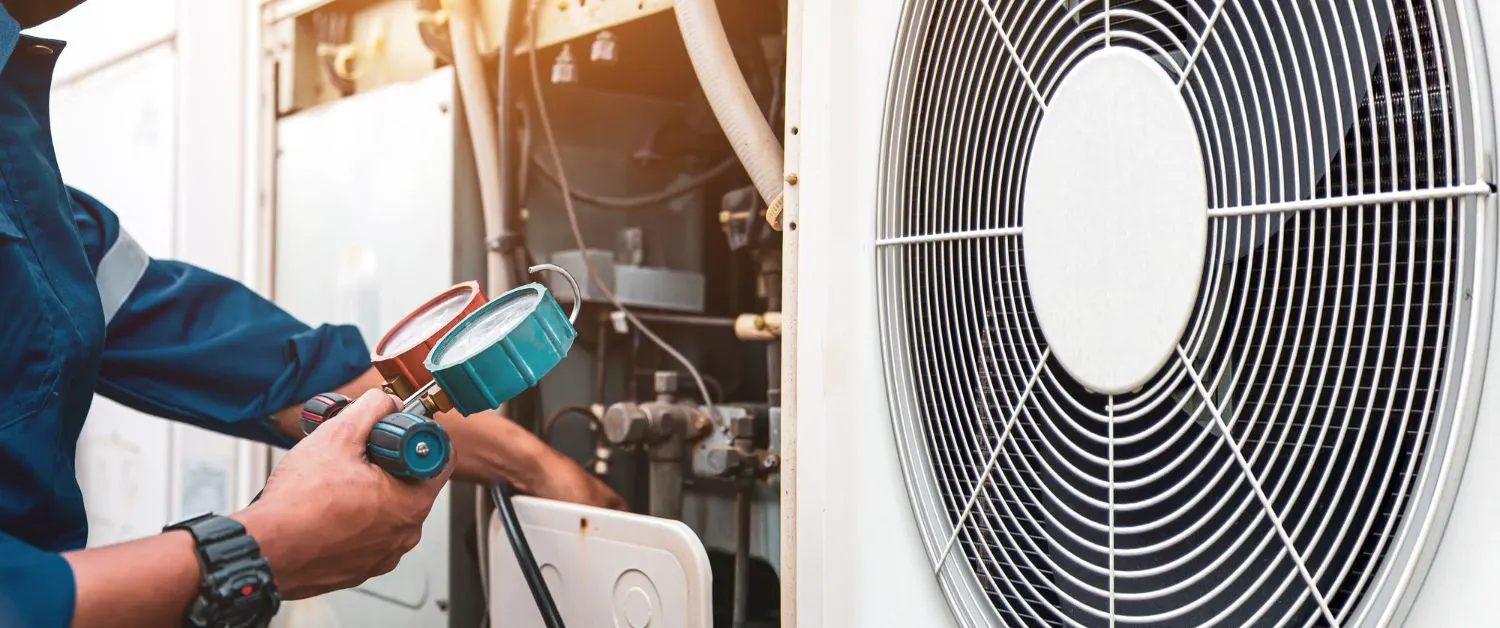
No AC in a South Florida Heat Wave? Here Is What to Do Right Now
Our dispatch line is monitored around the clock. While a technician is on the way, a few safe steps can protect your system and the people in your home.
Five Safe Steps Before the Technician Arrives
None of these involve opening the unit. If something here fixes it, great; tell dispatch so we can update the visit.
Check the thermostat
Set to Cool, set below room temperature, and fresh batteries if it uses them (Trane).
Look at the breaker, do not force it
If the AC breaker has tripped, Trane advises calling a professional instead of resetting it again and again.
Look for ice
Ice on the lines or coil: set Cool to Off and the fan to On to thaw it. Do not chip ice. Expect one to two gallons of water (American Standard).
Check the drain
A clogged condensate line can trip a float switch that shuts the system down to prevent water damage.
Swap a dirty filter
A clogged filter starves the coil of air and can be the whole problem.
When a Dead AC Becomes an Emergency
We prioritize by risk, not by who calls first. Tell dispatch if any of these apply.
- Someone at higher risk from heatOlder adults, infants, anyone with heart or breathing conditions, or someone on medications that affect heat tolerance.
- Heat advisory conditionsNWS Miami issues heat advisories for Broward when the heat index reaches 105°F for two hours or more; the 2024 Palm Beach County threshold was 108°F.
- Water actively leakingAn overflowing pan or a leak into a ceiling can turn a repair into drywall and mold work within hours.
- Burning smell or repeated breaker tripsTurn the system off at the thermostat and leave it off until it is checked.
Restarting Your AC After a Power Outage or Hurricane
Hurricane season runs June 1 to November 30 and peaks around September 10 (National Hurricane Center).
Safe to do yourself
- Give it five minutesMany systems have a time-delay relay that holds the compressor off for about 3 to 5 minutes after power returns; that protects the compressor (FPL).
- Bring loads back one at a timeWhen power is restored, FPL advises turning appliances on one at a time rather than all at once.
- Generator outdoors onlyRun generators outside, at least 20 feet from windows, doors and attached garages (Ready.gov), with a battery CO alarm inside.
- Before the stormFPL recommends turning off and unplugging non-essential electrical equipment before a storm.
Stop and call a pro
- Flooded outdoor unitDo not start it. Goodman advises having a qualified technician inspect flooded equipment first; replacement may be the better choice.
- Wet breaker panelDo not touch wet electrical equipment (Ready.gov). If you must reach a breaker, FPL says stand on something dry and non-conductive.
- Generator wiringNever backfeed a generator into the breaker box; a licensed electrician installs a transfer switch (FPL).
Keeping Cool Until the System Is Back
Close blinds on the sun side, keep doors to unused rooms shut, and move everyone to the coolest interior room. CDC guidance is that air conditioning is the strongest protection in extreme heat, that even a few hours in an air-conditioned place helps, and that fans alone will not prevent heat illness once temperatures reach the high 90s.
Once the system is running again, resist dropping the thermostat ten degrees. Let it pull down gradually so the coil does not ice and the system is not fighting a huge load at once.
Where We Handle Emergency AC Repair
Emergency calls route from dispatch in west Boca to the nearest available technician. Tap a pin for the city.
The interactive map is not loading right now. The areas it covers:
Questions About Emergency AC Repair
Is Direct Cooling really available 24/7?
Yes. The dispatch line at (561) 210-7605 is textable and monitored around the clock, and a technician follows up directly, including outside office hours.
Is it faster to text or call?
Either works. Texting lets you send photos of the thermostat, the outdoor unit label or any water, which helps the technician arrive with the right parts.
Should I keep running the AC if it is blowing warm air?
If you see ice or hear grinding or buzzing, turn it off. Running a frozen or failing system can damage the compressor.
Text Dispatch Now
Send a photo of the outdoor unit label and tell us what the system is doing. We will get a technician moving.
Sources · page reviewed 2026-10-06
- Trane, AC not turning on troubleshooting, read 2026-10-06
- American Standard, Frozen evaporator coil, read 2026-10-06
- National Weather Service Miami, heat safety, read 2026-10-06
- National Weather Service Miami, 2024 heat criteria change, read 2026-10-06
- CDC, Ask CDC: extreme heat guidance, read 2026-10-06
- NOAA National Hurricane Center, Tropical cyclone climatology, read 2026-10-06
- FPL, Power outage guide, read 2026-10-06
- FPL, Storm restoration safety, read 2026-10-06
- Ready.gov, Power outages, read 2026-10-06
- FPL, Storm preparation guide, read 2026-10-06
- Goodman, HVAC equipment after a flood, read 2026-10-06
- Ready.gov, Hurricanes, read 2026-10-06
- FPL, Generator safety, read 2026-10-06